Research in the Environmental Humanities recognises the need for better cooperation and concerted collaboration between the sciences and the humanities when it comes to understanding, assessing and ameliorating current and emerging environmental crises. This research identifies critical root causes, underlines the role of imaginaries, norms and values, and mobilises knowledge on the import of language and narrative as well as artistic expression in order to assemble more diverse and robust understandings of what it means to live in a world of polycrisis, and to develop novel solutions or pathways for safeguarding or restoring planetary co-habitability. In line with UNESCO’s latest global report on cultural policies, it thus appreciates “culture’s essential role in fostering inclusive and sustainable societies,” which makes culture “the missing SDG.”[1]
At the research hub for Multidisciplinary Environmental Studies in the Humanities (MESH) in Cologne, and together with international and transdisciplinary scholars and scientists, the projects HESCOR (Human & Earth System Coupled Research)[2] and Just Futures: An Interdisciplinary Approach to Cultural Climate Models[3] are trying to understand the role and function of models in the context of research on global environmental change and the human dimensions of reflection, understanding, and agency. Traditionally, models and modelling in these areas are associated with scientific and mathematical practice and have been described as one of the dominant ways in which societies make sense of the present and possible, probable, and desirable or undesirable futures.[4] However, our research has shown that there exist numerous other forms of models and modelling, and that integrative or interdisciplinary work at the nexus of the sciences and humanities as well as humanities-driven climate change research need to pay better attention to the various forms of cultural modelling, including their different registers and media (‘vernaculars’) and their diverse affordances. In sum, cultural climate modelling contributes to Futures Literacy by expanding society’s capacity to use the future differently, surface contested assumptions, and imagine plural rather than singular climate pathways.[5]
What are models?
There are many definitions and understandings of what models are. A pragmatic understanding is that models are medially transmitted representations of phenomena that are difficult or impossible to observe directly. In climate research, they are used to explain, backcast or project the development and behaviour of complex systems (e.g., the Earth system and its climate) or components of this system (e.g., the Greenland Ice Sheet). Despite their reliance on measured data points, mathematical formalization and different kinds of algorithms and equations as well as computation, they are never value-free and always used in specific cultural and societal contexts, which means that they fulfil particular functions as a projection of the assumed interaction between components of a system under certain normative constraints. Climate models so far cannot adequately integrate human consciousness and agency as well as societal and cultural dynamics.[6]
What is cultural modelling?
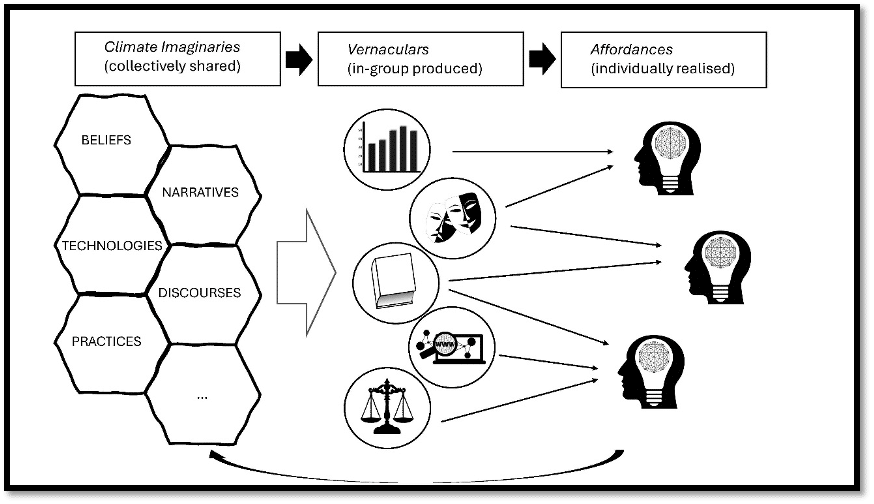
Cultural modelling sets in at this point and suggests that besides physical phenomena such as those represented by climate data and the formalization of the Earth’s physical and atmospheric processes, humanities-driven, integrative modelling must attend to the role of climate imaginaries, that is, “collectively shared sets of beliefs, narratives, technologies, discourses, and practices that condition what climate futures are thought of as possible, likely, or (un)desirable.”[7] This builds on the long-standing futures studies insight that a society’s dominant images of the future actively shape what becomes possible in its present.[8] Because the “creation, upkeep and decline” of imaginaries are influenced by “the material-discursive mediums through which they are produced, circulated, normalized and contested,” cultural research on modelling needs to consider these media and registers (“vernaculars”) as well as the differences affordances they entail.[9] Cultural climate modelling also creates opportunities to integrate Indigenous and local knowledge systems, whose narratives, temporalities and ecological understandings are often excluded from conventional climate models.[10] Climate imaginaries actively shape how humans think about and act in the face of climate change and thus change the evolution of climate itself.

The connection of collective shared, yet diffuse, climate imaginaries, in-group-produced and concrete vernaculars, and individually realised affordances as discussed in Just Futures; see 10.5281/zenodo.22727690.
Summary
Scientific, mathematical modelling to date is largely unable to integrate a sufficient and workable understanding of climate imaginaries and how they bear on human dimensions of consciousness, reflection and agency in the larger Earth system. The concept of cultural climate modelling provides insights into these dimensions as well as a commonly shared terminology in order to facilitate inter- and transdisciplinary research collaborations, which can ultimately build better Earth system models.
The humanities are also needed in such collaborations because models are not value-neutral, and their histories, contexts and impact on global environmental change research and policy must be integrated into climate change, Earth-system, and biodiversity research.[11]
Key Insight and Implications
Scientists and policy-makers should become more familiar with humanities-driven climate research that is attentive to the cultural dimensions of climate change, including established ones such as the storylines approach, and emerging ones, such as the cultural climate models approach.[12]
Specifically,
1. Cultural modelling expertise should be embedded in national or IPCC-adjacent scenario processes, and
2. Funding should be made available for joint humanities-science teams that collaborate at the scenario-design stage rather than after models are built to improve the quality of model design and multi-model assessments.
Humanities are not merely complementary to climate science; they are indispensable for understanding how societies imagine, negotiate and ultimately enact climate futures.
[1] UNESCO (2025) UNESCO Global Report on Cultural Policies: Culture – The Missing SDG. https://doi.org/10.58337/REJU6051.
[2] HESCOR is funded by the North-Rhine-Westphalian Ministry of Culture and Science (under grant no. PB22-081). More information can be found at https://www.hescor-project.com/.
[3] Just Futures: An Interdisciplinary Approach to Cultural Climate Models is funded by the Arts and Humanities Research Council (AHRC) under grant no. AH/X00189X/1, the Deutsche Forschungsgemeinschaft (DFG) under Grant No. 508231631 and the Österreichischer Wissenschaftsfond (FWF) under Grant No. I-6655-G. More information can be found at https://ccm.uni-koeln.de/.
[4] Hulme M (2022) Climate Change. Routledge, London.
[5] Miller, R (2018) Transforming the future: anticipation in the 21st century, UNESCO/Routledge.
[6] See, e.g., Beckage B et al (2020) The Earth has humans, so why don’t our climate models? Climatic Change 163, 181–188. https://doi.org/10.1007/s10584-020-02897-x.
[7] Hulme 2022, p. 230.
[8] Polak, F (1961) The image of the future, Elsevier; Bell, W (1997), Foundations of futures studies, Transaction.
[9] Davoudi S and Machen R (2022) Climate imaginaries and the mattering of the medium. Geoforum 137, 203–212, p.203, 207. https://doi.org/10.1016/j.geoforum.2021.11.003.
[10] Whyte, K (2017) Indigenous climate change studies: indigenizing futures, decolonizing the anthropocene, English Language Notes, 55,1–2.
[11] Pulkkinen K et al (2022) The value of values in climate science, Nature Climate Change 12, 4-6 (https://doi.org/10.1038/s41558-021-01238-9); Rivadeneira NR, Carton W (2022), (In)justice in modelled climate futures: A review of integrated assessment modelling critiques through a justice lens. Energy Research & Social Science 92:102781 (https://doi.org/10.1016/j.erss.2022.102781); Hussain S T and Baumann C (2024) The human side of biodiversity: coevolution of the human niche, palaeo-synanthropy and ecosystem complexity in the deep human past. Phil. Trans. R. Soc. B 379, 20230021 (https://doi.org/10.1098/rstb.2023.0021).
[12] Shepherd TG et al (2018) Storylines: An alternative approach to representing uncertainty in physical aspects of climate change. Climatic Change 151, 555–571. https://doi.org/10.1007/s10584-018-2317-9.
NOTE: This policy insights piece was written by Prof. Dr. Roman Bartosch, Hub Co-Director for BRIDGES Cologne.