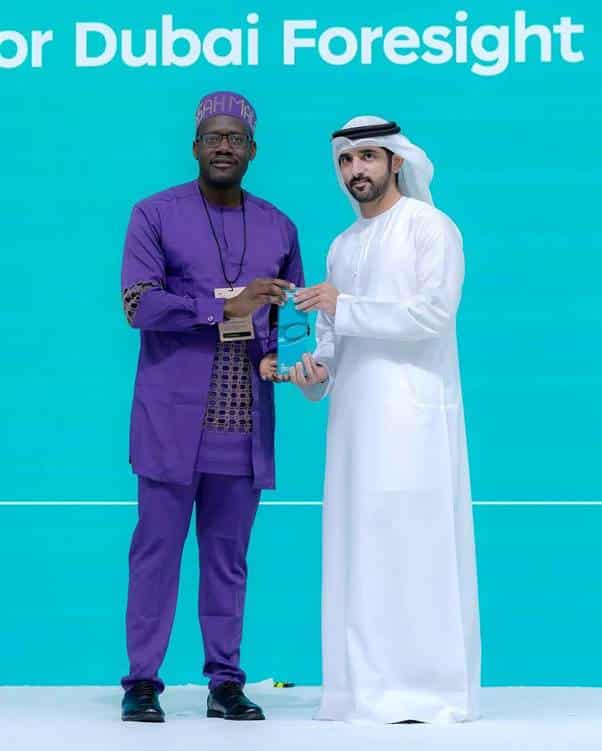
Congo Basin Futures (#CongoBasinFutures), a participatory foresight project led by Dr Nsah Mala, was honoured on Tuesday 18 November 2025 in Dubai as the Winner of the inaugural Dubai Foresight Awards in the Foresight for the Planet category.
Selected from hundreds of submissions across 50 countries and three finalists, #CongoBasinFutures emerged as the overall winner in its category.
The award trophy was handed over to Dr Nsah Mala on the seventh floor of the iconic Dubai Museum of the Future by His Royal Highness Sheikh Hamdan Bin Mohammed bin Rashid Al Maktoum, Crown Prince of Dubai, Deputy Prime Minister and Minister of Defence of the United Arab Emirates (UAE), during the 4th edition of the Dubai Future Forum. The annual event, which is the world’s largest gathering of futurists, brought together more than 2,500 futurists, academics, decisionmakers, and thought leaders.
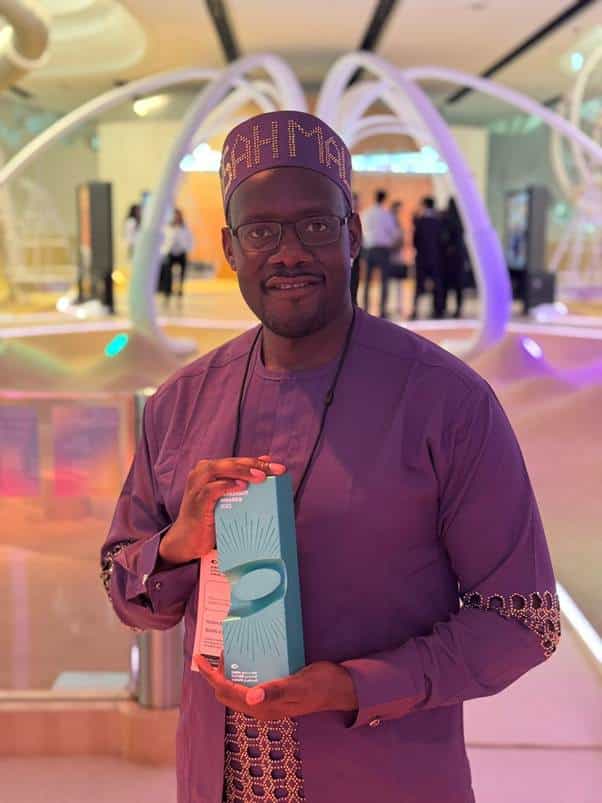
The Dubai Foresight Awards, instituted by His Highness Sheikh Mohammed bin Rashid Al Maktoum – the current ruler of Dubai and Prime Minister of the UAE – and administered by the Dubai Future Foundation, aim to “celebrate thinkers, innovators, and pioneers in foresight and future design from around the globe, highlighting their transformative achievements and vital contributions to creating a better future for humanity.”
Congo Basin Futures is a community project that Dr Nsah Mala initiated and leads. It deploys participatory foresight methodologies, storytelling, and indigenous knowledge to explore alternative futures for the Congo Basin tropical rainforests, the second-largest in the world. The project seeks to identify both undesirable and preferred futures or hopeful futures. By doing so, the project seeks to shape present-day policy and action to safeguard the Congo Basin tropical rainforests and ecosystems for current and future generations—humans and nonhumans alike, including culturally significant biodiversity such as royal animals used in some Cameroonian indigenous kingdoms (#RoyalAnimalsFutures).
According to Dr Nsah Mala, a multiple award-winning futurist, poet, writer and researcher, this international recognition represents a significant achievement for the Congo Basin ecosystems and for all project participants and partners. And the team is hoping to secure additional funding to continue advancing work under #CongoBasinFutures in other countries of the Congo Basin, which cut across Cameroon, Central African Republic (CAR), the Democratic Republic of the Congo (DRC), the Republic of Congo (RoC), Equatorial Guinea, and Gabon.
Following the win, Dr Nsah Mala has expressed special gratitude to all project contributors, particularly the Kings of Mbessa, Oku, Din-Noni, and Ajung, as well as the diverse group of collaborators—environmentalists, journalists, writers, teachers, nurses, security officers, designers, and others—who took part in online and Yaoundé workshops in 2024. Their collective effort made this success possible, he admits.
The milestone of the Dubai Foresight Awards follows earlier recognition and support from the School of International Futures (SOIF) through the 2023 Next Generation Foresight Practitioners (NGFP) Fellowship (Judges’ Choice), and from the University of Cologne through the UNESCO-MOST BRIDGES Coalition, MESH – Multidisciplinary Environmental Studies in the Humanities, Global South Studies Centre (GSSC), and the Sharing a Planet in Peril initiative. The recognition also builds on the International Prize for Francosphere Theses in Foresight and Futures Studies or Prix de thèses francophones en Prospective (2022), awarded to Dr Nsah Mala by Agence Universitaire de la Francophonie (AUF) and Fondation 2100.
The announcement of the award came as COP30 was held in Belém, Brazil, where the Belém Call to Action for the Congo Basin Forests was launched to mobilize over $2.5 billion within the next five years to protect the Earth’s second largest tropical rainforest. According to Dr Nsah Mala, this renewed global commitment offers a glimmer of hope and reinforces ongoing efforts to preserve the Congo Basin, despite the larger failures of COP30.
NOTE: This article was first published by The Ijim Times newspaper in Cameroon.