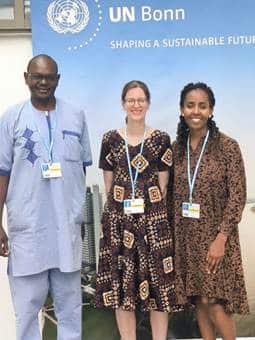
Gerda Kuiper (University of Cologne), Daniel Olago (University of Nairobi), and Juliet Wanjiku Kamau (Bonn University)
This Cologne Policy Insights series highlights the need for sustained exchange and collaboration between policy-makers and scientists in order to synergize efforts for addressing multiple planetary crises instead of working in silos. The current blogpost is based on a few insights from our attendance at the SB62 meeting of the United Nations Framework Convention on Climate Change (UNFCCC) in June 2025. This annual meeting in Bonn is informally known as the “pre-COP”, and is meant as a preparation for the larger Conference of Parties (COP) taking place toward the end of the year (this year in Belém, Brazil). Despite this meeting being much smaller than the COP itself, it was still impressive to see thousands of policy-makers, decision-makers, representatives from Local and Indigenous Communities (often in beautiful attire), and scientists gather in Bonn, engaging in panels at side events and in actual negotiations about policy texts. Two observations stood out to us during the day we could attend as observers for the University of Cologne:
- There seems to be a deep realisation among the participants that various planetary crises must be thought together. For instance, biodiversity loss was a crucial theme in discussions at this meeting, despite the main focus being on climate change mitigation and adaptation.
- The concept of Nature-based Solutions (NbS) has gained a firm foothold in this kind of high-level science-policy meetings. NbS is a term derived from policy and now adopted by scientists, pointing at solutions that work with (instead of against) nature and that have multiple ecological and societal benefits. According to the UN Environmental Assembly (UNEA-5), “nature-based solutions are actions to protect, conserve, restore, sustainably use and manage natural or modified terrestrial, freshwater, coastal and marine ecosystems which address social, economic and environmental challenges effectively and adaptively, while simultaneously providing human well-being, ecosystem services, resilience and biodiversity benefits.” Concrete examples of such NbS are agroforestry and urban greening, but the range of solutions that can fit under this umbrella is broad.
Published Research
NbS for climate change adaptation and biodiversity conservation are the main focus of the DAAD Global Climate and Environment Centre “Future African Savannas” (AFAS). AFAS is a cooperation between the Université Félix Houphouët Boigny (Côte d’Ivoire), University of Nairobi (Kenya), University of Bonn and University of Cologne (both in Germany).
The AFAS team published the open-access article “Nature-based solutions in the savanna belt of Africa: Insights from a systematic review” last year. The review indicated that case studies of NbS in Africa’s savannas are limited to a handful of countries and the focus is skewed towards specific types of solutions, mainly in smallholder agriculture, which are then analysed in isolation (without connecting to insights on other types of NbS). Moreover, research agendas are largely set in the Global North, with scientists from northern countries cooperating with African partners; however, South-South exchange and cooperation in developing locally fit-for-purpose NbS is very limited.
Policy recommendations
Several recommendations follow from the conclusions in the review, which can be categorized according to different forms of scaling as recently identified in the IPBES Assessment report 2024:
- Scale out: break knowledge siloes by building on insights from various types of NbS and from different geographical regions;
- Scale down (simultaneously!): embed NbS in local ecological and social circumstances;
- Scale deep: ensure a locally-driven agenda, based on collaboration between African institutions as much as with institutions from the Global North, for the further development and implementation of NbS for climate change adaptation and biodiversity conservation.
Targeted decision- and policy-makers
The insights from the UNFCCC SB62 meeting and the recommendations derived from the published article on NbS in savannas are relevant for myriad Africa-based institutions working or researching on the science-policy-practice interface. Moreover, scientific (funding) institutions from the Global North working on this topic in the Global South should take note of the recommendations on breaking down scientific silos and prioritizing locally relevant insights and solutions.

Photo description: AFAS delegates at the UNFCCC SB62 meeting in June 2025: Prof. Daniel Olago from the Institute for Climate Change and Adaptation of the University of Nairobi, Dr. Gerda Kuiper of the Global South Studies Centre of the University of Cologne, and Dr. Juliet Kamau from the Centre for Development Studies of the University of Bonn.